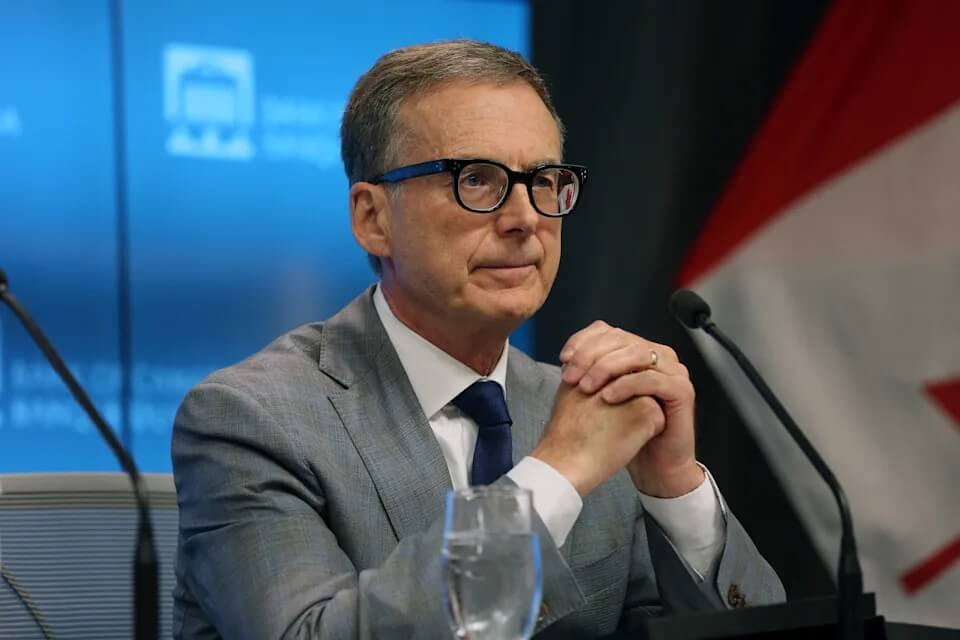
The Bank of Canada (BoC) held its overnight interest rate steady at 2.25 per cent on Wednesday in a move widely expected by economists, as policymakers weighed the inflationary impact of surging oil prices against signs of weakness in the Canadian economy.
The BoC “will look through the war’s immediate impact on inflation,” Governor Tiff Macklem said. “But if energy prices stay high, we will not let their effects broaden and become persistent inflation.”
He highlighted the “dilemma” facing policymakers, with the war adding upward inflationary pressure to an economy weakened by the ongoing trade dispute with the U.S.
“Raising interest rates to slow inflation could further weaken the economy,” Macklem said. “Easing interest rates to support growth risks pushing inflation well above target. Canada’s outlook is further complicated by structural change — shifting trade relationships, the adoption of AI, and changes in demographics.”
Macklem and senior deputy governor Carolyn Rogers both emphasized that the Bank would watch closely for signs that prices for goods and services outside energy were rising, and that the duration and scale of the Iran war are key unknowns.
Economists were broadly unsurprised by the call — a Reuters survey before the announcement noted unanimous expectations for a hold. Most expect the BoC to remain on hold for the rest of 2026, but with uncertainty around the Iran conflict, making a clear outlook even more difficult.
“The war in the Middle East is the dominant factor here. How long it disrupts supplies of energy products and other goods is the determinant of how big the associated inflationary impact will be,” senior economist Andrew Hencic wrote on Wednesday.
“We don’t have reason to alter our call for the Bank of Canada to be on hold this year, in part because we have no greater visibility than the Bank on how long the oil shock will persist,” CIBC chief economist Avery Shenfeld said.
Beyond the focus on energy prices and the Iran conflict, several economists saw a dovish tone in the BoC’s view on the Canadian economy. BMO chief economist Douglas Porter said it was “abundantly clear” that the BoC had been concerned about economic weakness before the war came into focus, “and would have been even more dovish in today’s statement were it not for the spike in oil prices.”
Inflation watch
Macklem acknowledged that higher gas prices would show up in the next inflation report, but wouldn’t offer timeframes under which the BoC would feel compelled to act. He noted that “the issue for us is not really the immediate increase in inflation — we know that’s going to happen. It’s: does that start to get generalized, start to spread, start to look more persistent?”
Evaluating that, Macklem said, will depend a lot on core measures of inflation, which “tend to strip out volatile components like energy, so they’ll give you an idea of what’s happening to everything else.” The BoC will also monitor price distribution in the Consumer Price Index to gauge whether more components are rising faster.
The Bank is also watching for signs that higher gas and food prices could begin to influence broader inflation expectations.
Inflation has been near the BoC’s two per cent target for more than a year, Macklem said, and various core measures are now also close to that target — giving the BoC some breathing room.
“There isn’t a lot of sort of pent-up inflationary pressure in the economy,” he said. “So against that background, you know, we don’t think this is going to spread quickly. So we’ve got some time.”
Macklem and Rogers said the BoC has learned lessons from how inflation was handled during the pandemic, when inflation and interest rates skyrocketed.
“When we went into the supply shock coming out of the pandemic, the economy was overheated,” Rogers said. “That made it easy for price increases to get passed on, but they were coming from a supply shock. We’re not in that same situation now.”
The BoC’s next rate announcement is on April 29, at which the Bank’s next quarterly Monetary Policy Report, detailing its outlook for the economy and inflation, will be released. Yahoo Finance